Sand for Block Paving and Cobbles: Which Sand to Use for the Bedding Layer
 By David Polido, CEO of Chambino Areias and INERCOR
Chambino Areias supplies sand in Portugal only (Seixal, near Lisbon). Prices exclude VAT; delivery to site from 5 t across the Lisbon and Setúbal region; smaller orders are collected at the pit.
Quick answer
To lay block paving (concrete pavers), blocks or cobbles, the bedding layer between the compacted sub-base and the blocks normally uses a 0/4 sand. At Chambino Areias there are two 0/4 options: pit sand 0/4, which lists "bedding and levelling layers" among its uses, and coarse washed sand 0/4, which also works. Both carry CE marking under EN 12620.
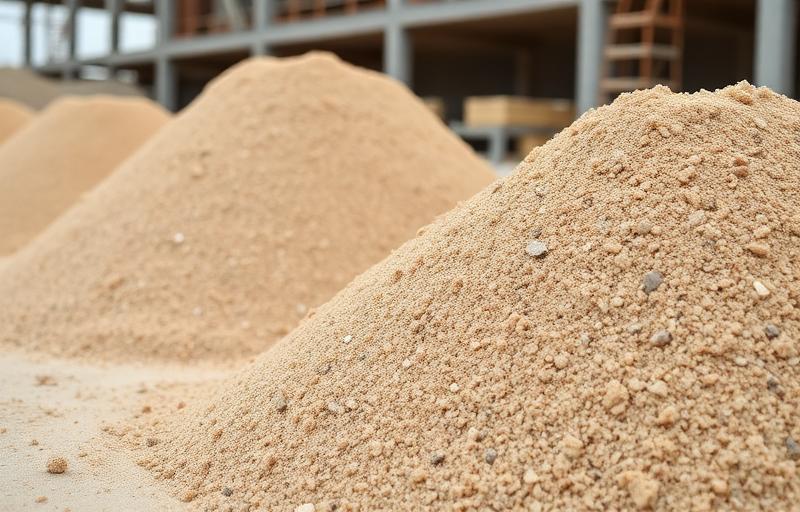
Where the sand goes in block paving
Put simply, a block pavement has three parts:
- Sub-base: the compacted supporting layer that takes the loads.
- Bedding layer: sand spread and levelled over the sub-base, where the blocks are laid.
- Joints: the gaps between blocks, which many systems fill with fine sand.
When people search for "bedding sand" or "sand for pavers", they mean the second layer. It is not what gives the pavement its strength (that is the sub-base's job), but it sets the level and supports the blocks evenly.
Which sand to use
Pit sand 0/4. Sold as extracted, without washing. Grains from 0 to 4 mm, placed on the market with CE marking (EN 12620, DoP on request). Its product sheet lists bedding and levelling layers, fill and outdoor work. Sold in big bags and 25 kg bags; see current prices on the pit sand 0/4 product page.
Coarse washed sand 0/4. Same grading, but washed. It also works for the bedding layer. Sold in big bags, 25 kg bags and, unlike the other sands, in bulk. For larger quantities, bulk is usually the cheapest format per tonne; see current prices on the washed sand 0/4 product page.
Fine sand 0/1 for the joints. When the paving system calls for sand-filled joints, a fine sand is used. Fine washed sand 0/1 lists "joints and detail work" among its uses. Always check with the block manufacturer which material they specify for the joints.
Thickness and compaction
The thickness of the bedding layer depends on the type of block, the use (foot traffic or vehicles) and the sub-base. Follow the project or the paving manufacturer's instructions.
In general terms, the sequence is:
- Compact the sub-base before spreading the sand.
- Spread the sand evenly and screed it level with a straight edge, without walking on it once levelled.
- Lay the blocks on the levelled sand.
- Compact the pavement with the blocks in place, as the manufacturer instructs, and fill the joints.
The sand should be free of soil, roots and building debris. If it is stored on site, keep it covered from the rain.
How much to order
The sum has two steps: area × thickness = volume (m³); volume × 1.6 = tonnes.
Example, only to illustrate the sum: a 40 m² patio with a 3 cm (0.03 m) layer, if that is the thickness specified.
40 m² × 0.03 m = 1.2 m³
1.2 m³ × 1.6 t/m³ ≈ 1.9 t
In big bags (≈ 1 t each): 2 big bags, pit sand or washed sand
In 25 kg bags (40 bags = 1 t): about 77 bags
Add a small margin for waste and level adjustments. The simulator (in Portuguese) does these sums for you; see also how to calculate the amount of sand and how much a cubic metre of sand weighs.
Delivery and collection
Delivery to site, within 24-48 h, is from 5 t across the Lisbon and Setúbal region (outside it, on request, also from 5 t). Below that quantity, as in the example above, the order is still taken, for collection at our sand pit in Seixal. Product page prices exclude VAT and delivery.
Where to order
See the product pages for pit sand 0/4, coarse washed sand 0/4 and fine washed sand 0/1. Ask for a quote with the area, the site location and the format you want. If you are still choosing the material, compare the types of sand for construction.
Frequently asked questions
Which sand is used to lay block paving?
Normally a 0/4 sand. Pit sand 0/4 lists bedding layers among its uses; coarse washed sand 0/4 also works.
Can I use fine sand for the bedding layer?
The bedding layer normally uses 0/4. Fine sand 0/1 is generally kept for the joints, where the system calls for it.
How thick should the sand layer be?
It depends on the block, the use and the sub-base. Follow the project or the paving manufacturer's instructions.
Does pit sand have CE marking?
Yes. It is placed on the market with CE marking under EN 12620, and the Declaration of Performance (DoP) can be requested from Chambino.
How many bags of sand do I need per m²?
It depends on the thickness. At 3 cm, each m² takes about 0.048 t (0.03 × 1.6), close to 2 bags of 25 kg.